

LANDSEER
The Landseer is a large, black-and-white working dog recognized by the Fédération Cynologique Internationale (FCI) as the Landseer (European Continental Type). Affectionate and physically powerful, it suits homes prepared for substantial exercise, training, grooming and everyday giant-dog logistics.
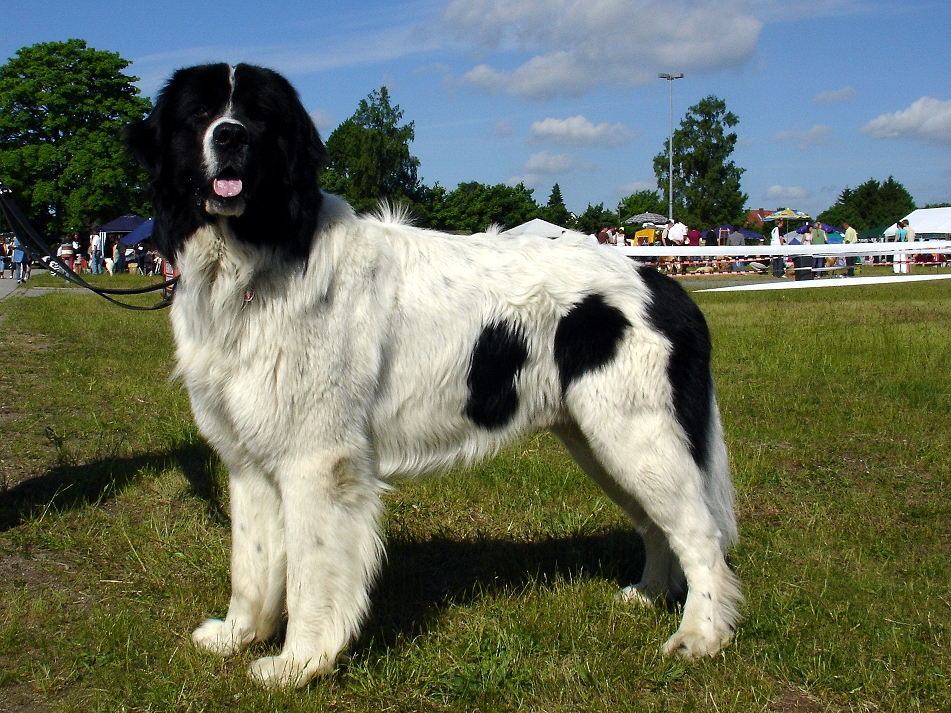
| Origin | Developed in continental Europe from black-and-white Newfoundland-type dogs, with German and Swiss breeders playing important roles in establishing the European Continental Type. |
|---|---|
| Group | FCI Group 2: Pinscher and Schnauzer, Molossoid and Swiss Mountain and Cattledogs; Section 2.2, mountain-type Molossoids. |
| Size | Giant |
| Height | FCI standard: males 72–80 cm and females 67–72 cm at the withers, allowing small deviations above or below these ranges. |
| Temperament | Generally affectionate, sociable and composed, with individual differences in confidence, energy and independence. |
| Exercise | Needs daily walks, opportunities to explore and regular mental engagement. Swimming can be useful when the dog enjoys it and conditions are safe. |
| Grooming | A dense double coat needs thorough brushing several times a week, with additional work during seasonal shedding and after swimming. |
| Trainability | Usually receptive to patient, reward-based teaching. Early practice with loose-lead walking, recall and calm greetings is essential because of the dog's eventual size. |
About the breed
The Landseer's background lies in the black-and-white Newfoundland-type dogs brought to Europe from the North Atlantic region. These dogs were associated with waterside work, swimming and hauling. The name commemorates British artist Sir Edwin Landseer, whose paintings helped popularize their distinctive appearance.
Continental European breeders developed a population with a taller, more leggy outline than the modern Newfoundland. The FCI recognizes this European Continental Type as a separate breed. Terminology matters: in some registries and everyday usage, “Landseer” instead describes a black-and-white Newfoundland, not this distinct breed.
Today, Landseers are primarily companions, although their working heritage can find an outlet in suitable water activities and other cooperative training. They are best matched with people who want close daily involvement with a very large dog and can manage its strength, coat, feeding costs and transport needs.
Appearance
The breed has a strong, balanced frame, a broad head, triangular drop ears and a long, well-furnished tail. Its outline is notably more leggy than a Newfoundland's. Under the FCI standard, the coat is predominantly clear white with distinct black patches on the body; the head is black, with a white muzzle and symmetrical white blaze considered desirable. The long coat has a dense undercoat and may show some wave.
Temperament & personality
Many Landseers form close family attachments and enjoy participating in household life. A generally steady disposition does not eliminate exuberant adolescent behavior or guarantee comfort with every visitor, dog or unfamiliar situation. Supervise interactions with children: even friendly movement can knock someone over. Introductions to other animals should be gradual and managed.
Exercise requirements
Build an adult routine around comfortable walks, sniffing, short training sessions and opportunities for free movement in secure areas. Increase fitness gradually rather than assuming swimming ancestry makes every individual a strong or willing swimmer. Use safe entry and exit points and avoid currents, excessive cold and exhaustion. For puppies, favor self-paced activity and avoid forced running or repetitive jumping; seek veterinary guidance as they grow. Schedule activity for cooler conditions in warm weather.
Training
Teach practical skills before the dog becomes difficult to physically manage: walking without pulling, waiting at doors, settling on a mat and entering a vehicle safely. Make handling of paws, ears and coat rewarding from puppyhood. Introduce people, surfaces, travel and everyday noises gradually, without overwhelming the dog. Use consistent rewards and clear boundaries rather than physical confrontation. Practice comfortable periods alone to support independence.
Grooming
Brush through to the skin, concentrating on the areas behind the ears, armpits, belly and feathering where tangles can develop. A slicker brush and metal comb help check that the coat is fully detangled. After swimming, rinse away salt or debris and dry the coat thoroughly, including skin folds and the areas around the ears. Keep nails short and brush teeth regularly. Routine shaving is not a substitute for double-coat maintenance.
Nutrition
Feed a complete, balanced diet suitable for life stage and body size. Puppies need a diet formulated for large-breed growth, with controlled portions rather than feeding for maximum size. Avoid adding calcium or other growth supplements unless prescribed. Adjust meals to body condition and activity, accounting for training treats. Discuss meal management and gastric dilatation-volvulus risk with a veterinarian; no feeding routine guarantees prevention.
Health considerations
Prioritize documented breeding-stock assessments for hips and elbows, and ask which additional examinations or DNA tests are recommended for the local Landseer population. A veterinarian should advise on cardiac evaluation and any relevant inherited conditions rather than assuming Newfoundland testing guidance applies unchanged. Maintain a lean body condition and monitor mobility, skin and ears. As with other large, deep-chested dogs, discuss gastric dilatation-volvulus and preventive options with a veterinarian. Unproductive retching, abdominal swelling, distress or collapse requires immediate emergency care.
Lifespan
A dependable breed-specific lifespan estimate needs verification, especially because published figures may conflate European Continental Landseers with black-and-white Newfoundlands. Ask breeders about documented longevity and causes of death in related dogs. Plan for age-related mobility support, accessible sleeping areas and veterinary care throughout life.
Is this breed right for you?
A Landseer may suit a household that enjoys outdoor activity, accepts heavy coat maintenance and can provide consistent companionship and training. A garden is useful but does not replace outings or interaction. Consider stairs, slippery floors, vehicle space and whether you could transport an injured adult. The breed is less suitable if low upkeep, minimal shedding, prolonged daily isolation or easy physical handling are priorities.
Pros
- Often affectionate and closely involved with family life.
- Can enjoy cooperative training and carefully managed water activities.
- A generally composed companion when well socialized and appropriately exercised.
Considerations
- Giant size brings substantial food, equipment, transport and veterinary costs.
- Heavy shedding and a dense coat require sustained grooming.
- Early manners training is necessary to manage strength and adolescent exuberance.
- Heat and strenuous activity require careful management.
- Registry terminology can confuse the distinct breed with the Newfoundland color variety.
Similar breeds
Newfoundland — closely related historically; a black-and-white Newfoundland is not automatically a European Continental Landseer.Leonberger — another giant companion with a substantial coat and significant space and care needs.Saint Bernard — comparable giant-dog handling and cost considerations, but a separate history, structure and breed standard.
ROTTLE challenge
Think you know this breed? Can you identify it in six guesses?
Play ROTTLE